How to Choose the Best Photoelectric Sensors for Your Needs?
Choosing the right Photoelectric Sensors can be daunting. With various types and technologies available, decisions are crucial. Photoelectric sensors play a key role in automation, detection, and safety applications. However, not every sensor suits your specific needs.
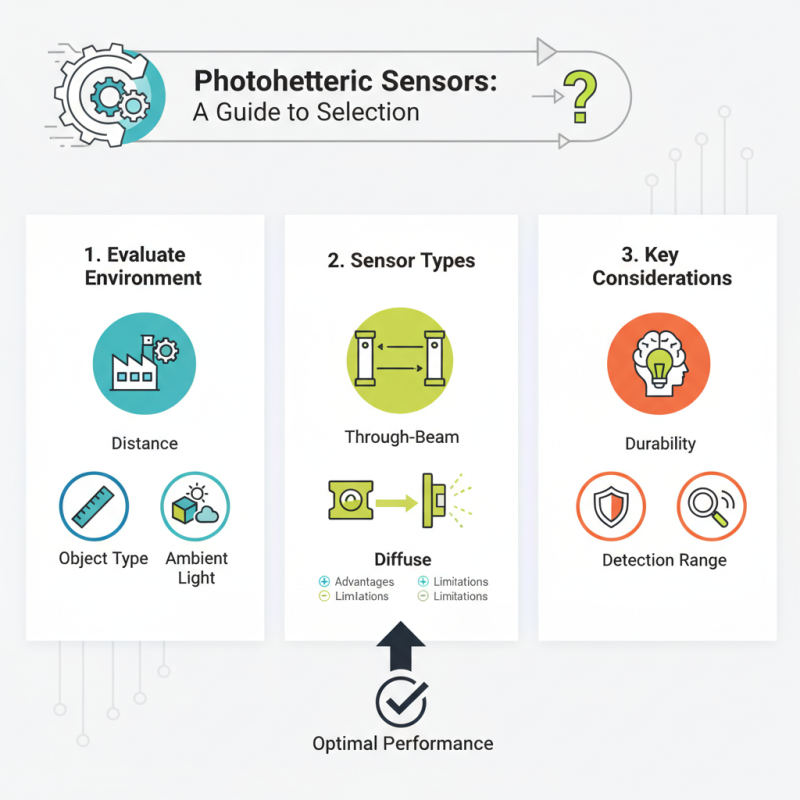
Different applications require different features. For example, some environments may demand sensors with high durability, while others require extensive detection ranges. It’s essential to evaluate the specific environment where the photoelectric sensors will be used. Consider factors like distance, type of object to detect, and ambient light conditions.
Several options exist, including reflection, through-beam, and diffuse sensors. Each type has its advantages and limitations. This variety can make decisions harder. You may feel overwhelmed by technical specifications. Taking time to reflect on your needs will lead to better choices. Focus on practical aspects that matter most for your operations. Ultimately, understanding your requirements ensures you select the best photoelectric sensors for optimal performance.
Understanding Different Types of Photoelectric Sensors and Their Applications
Photoelectric sensors are essential devices in automation. They use light to detect objects, providing accuracy in various applications. Understanding their types helps in selecting the right sensor. There are four common types: reflective, through-beam, proximity, and color sensors.
Reflective sensors are ideal for detecting objects at short ranges. They are simple and cost-effective. In contrast, through-beam sensors offer longer sensing distances. They have a transmitter and receiver placed apart. Proximity sensors are used when a touchless operation is required. They can detect objects within a specific range without direct contact. Color sensors are distinct. They identify different colors, essential in sorting processes.
According to industry reports, the global photoelectric sensors market is expected to reach $3.5 billion by 2025. This growth is driven by increasing automation in manufacturing. However, choosing the wrong type of sensor can lead to false readings and operational inefficiencies. Often, users overlook factors like environment and object characteristics. Attention to these details is vital for success.
Key Factors to Consider When Selecting Photoelectric Sensors for Your System
When choosing photoelectric sensors, several key factors come into play. The sensor type is fundamental. There are through-beam, reflective, and diffuse types. Each serves different applications. Understanding your system's requirements is crucial. For instance, if the distance is great, consider a through-beam sensor.
Detection range is also vital. You need a sensor that reliably detects objects within your specified range. Consider both the minimum and maximum distances. Additionally, environmental conditions matter. Sensors meant for harsh environments must have protective enclosures. Dust, moisture, or extreme temperatures can affect performance.
Accuracy and response time hold significant weight as well. Evaluate how quickly the sensor must register an object. An application with fast-moving items requires a faster response time. Reflect on these aspects thoroughly. Ideally, local applications should drive your decisions. Test different models and configurations. It's a process filled with trial and error.
Evaluating Sensor Specifications: Range, Response Time, and Sensitivity
When choosing photoelectric sensors, specifications like range, response time, and sensitivity play crucial roles. The range determines how far the sensor can detect an object. Typical ranges can vary from 0.1 meters to over 10 meters. However, selecting a sensor with a longer range may not always be necessary. In applications where close detection is sufficient, a shorter range can save costs.
Response time is vital for applications requiring quick detection. Many industrial sensors might have response times under 1 millisecond. But what if your application is less demanding? A sensor with a slightly higher response time could be adequate. Think about your specific needs—speed isn’t always the top priority.
Sensitivity affects how well a sensor detects different materials and colors. Some sensors might respond to dark surfaces better, while others excel with light ones. A report from a leading sensor manufacturer shows that dynamic environments often confuse sensors, leading to inconsistent performance. Thus, testing the sensor in real conditions before purchase is advisable. Be critical; sometimes, specifications look great on paper, but practical results can differ.
Photoelectric Sensor Specifications Comparison
Importance of Environmental Ratings in Photoelectric Sensor Selection
When selecting photoelectric sensors, environmental ratings play a vital role. These ratings define how well sensors can withstand different conditions. Sensors need to be suitable for their operating environment. Water, dust, and temperature extremes can all affect performance. An IP (Ingress Protection) rating indicates the level of protection against solid and liquid intrusions. A higher rating often means better reliability in harsh conditions.
For instance, in a manufacturing plant, dust might be prevalent. A sensor with a low IP rating could fail quickly. Similarly, in outdoor applications, temperature shifts can be significant. It’s important to choose sensors that can handle these fluctuations. Some users overlook these details, leading to unexpected failures. Testing sensors in real-life scenarios can help gauge their effectiveness.
Also, think about how the sensor placement impacts its durability. In some cases, a sensor might be exposed to direct sunlight or other elements. This exposure can degrade performance over time. Using protective housing can mitigate these risks, but it adds complexity. Regular maintenance checks become essential, which some might neglect. Ultimately, understanding environmental ratings aids in making a more informed choice.
Comparative Analysis of Leading Photoelectric Sensor Brands and Models
When selecting photoelectric sensors, understanding different brands and models is crucial. Each brand offers unique features, so it’s important to explore their strengths and weaknesses. For example, one model might excel in detecting small objects, while another may struggle. This variance can lead to unanticipated issues in real-world applications.
Consider the sensing range and type offered. Some sensors operate effectively over long distances, while others are more suited to shorter ranges. If a sensor lacks adequate range, it can fail to detect objects promptly. This might cause a bottleneck in manufacturing lines, leading to decreased efficiency. Additionally, the build quality should not be overlooked. A durable sensor might be more expensive upfront, but it can save costs in repairs and replacements over time.
Furthermore, user feedback is often revealing. It highlights both positive and negative experiences. Some users report difficulties with installation, while others praise the ease of setup. Identifying these aspects can help you avoid potential pitfalls. It’s essential to assess your specific needs thoroughly. Each application may reveal unforeseen challenges; being prepared for them is half the battle.